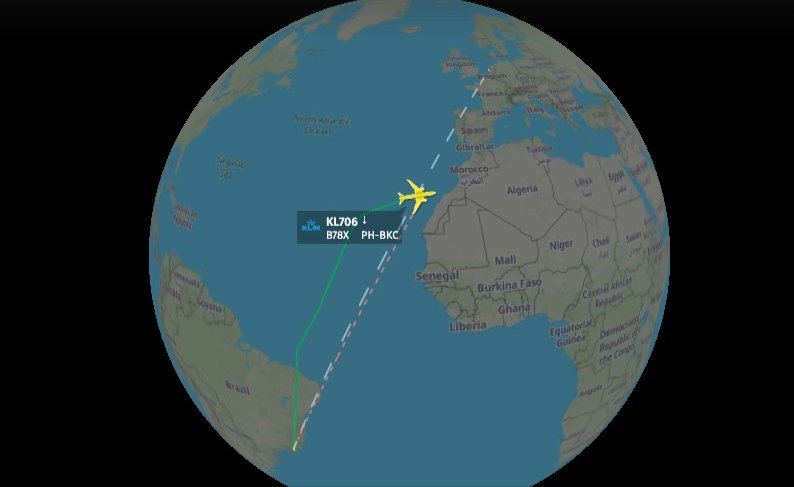
On Monday morning, a potential mid-flight medical emergency caused an unplanned diversion of a KLM Royal Dutch Airlines flight headed for Amsterdam to the Canary Islands.
On Sunday, July 19, at around 10:00 PM BRT, KLM Flight KL706, a Boeing 787-10 Dreamliner (registration PH-BKC), took off from Galeão International Airport (GIG) in Rio de Janeiro. Crew members started the diversion over the Atlantic Ocean around seven hours into the aircraft’s planned 11-hour transatlantic flight to Amsterdam Schiphol Airport (AMS).
On July 20, at around 9:30 AM local time, the widebody aircraft successfully landed at Tenerife South Airport (TFS).
Our research and preliminary tracking data indicate that a “possible medical situation” involving a passenger or crew member on board was the reason for the diversion. On the Tenerife tarmac, emergency medical personnel greeted the aircraft to offer prompt aid.
According to KLM, the inconvenience will only last a short while. In order to address the medical emergency, refuel, and prepare the cabin, the airline is currently planning a short one-hour layover in Tenerife.
With an estimated delay of almost two hours after its initial arrival time at Schiphol, Flight KL706 is scheduled to begin its journey to Amsterdam shortly. KLM has not disclosed any other information about the person’s identify or health.
A 67-year-old passenger on KLM flight KL706 from Rio de Janeiro (GIG) to Amsterdam (Boeing 787-10 registered PH-BKC) experienced a suspected heart attack during the flight, prompting an emergency diversion to Tenerife South Airport on Sunday.
The crew asked for an immediate diversion to Tenerife, which was thought to be the best airport for a priority landing, even though the aircraft was outside Canary Islands airspace at the time of the medical emergency.
In order to expedite the passenger’s access to critical medical care, air traffic controllers cleared the aircraft for the most direct route to Tenerife South.
About an hour and fifteen minutes after the emergency was declared, medical teams met the aircraft on the apron after it landed. Emergency services had been mobilised prior to the aircraft’s arrival. Before being taken to the hospital for additional care, the passenger was stabilised.