According to impact models, the asteroid strike that occurred 66 million years ago resulted in a planetary-scale conflagration that completely destroyed dinosaurs worldwide.
At the conclusion of the Cretaceous Period, the asteroid known as Chicxulub, which was 10 to 15 kilometres wide, fell in what is now the Gulf of Mexico.
Up until recently, it was believed that worldwide extinctions were mostly brought on by a “nuclear winter,” in which dust blocks out the sun and causes significant cooling, and that the majority of the worst consequences of heat and fires would have been rather regional.
After analysing geological evidence and impact simulations in the lab, Brandon Johnson and his colleagues at Purdue University in Indiana discovered that the strike vaporised around five times as much material as previously believed.
According to the latest research, a cloud of rock vapour was launched tens of thousands of kilometres into space following the impact and eventually dispersed high above the entire planet.
Over 1000 cubic kilometres of rock are vaporised in a matter of seconds when the impactor first hits the Earth, according to Johnson.
He claims that a few seconds later, the vapour plume spread into space above a large portion of Earth’s atmosphere, causing dust and spherules—glassy, metallic beads—to condense from the vapour.
According to the study, this massive cloud of vapour eventually transformed into 1.6 trillion tonnes of dust, which covered the earth and trapped heat. The heavier spherules, meanwhile, crashed back into the atmosphere.
Friction slows down and warms the spherules when this material re-enters the atmosphere over the next few hours, producing a thermal radiation pulse that lasts for about an hour, according to Johnson.
“This was strong enough to ignite forest litter like grass and pine needles, and may have even been enough to ignite trees, killing off creatures that couldn’t find shelter from it.”
According to the geologic record, the subsequent fires might have persisted for years and would have resembled the bushfires that are currently raging around Europe, but on a worldwide scale, he claims.
According to Johnson, “the Cretaceous animals would have received 17 times the dose of thermal radiation that is 100% lethal to humans.” “Even thick-skinned dinosaurs should be wiped out by that.”
According to Craig O’Neill of Queensland University of Technology in Australia, the study demonstrates that the planet’s surrounding dust layer was essentially opaque to visible and infrared light, trapping the heat.
According to O’Neill, each joule of heat produced by arriving spherules is transformed into a thermal pulse that bakes the Earth’s surface. “The land is transformed into the largest barbecue in history for approximately thirty minutes.”
But, he maintains, this isn’t the whole story. For instance, the incident had a negative impact on ocean life as well, leading to the extinction of numerous marine creatures like ammonites and mosasaurus. According to O’Neill, the consequences of a nuclear winter that blocks out the light on photosynthesising organisms—rather than an atmospheric heat pulse—better explain this.
Mass extinction events are sometimes viewed as murder mysteries that could be solved if the murder weapon could be located. However, he claims that large extinctions appear to be more like a chain reaction of failures.
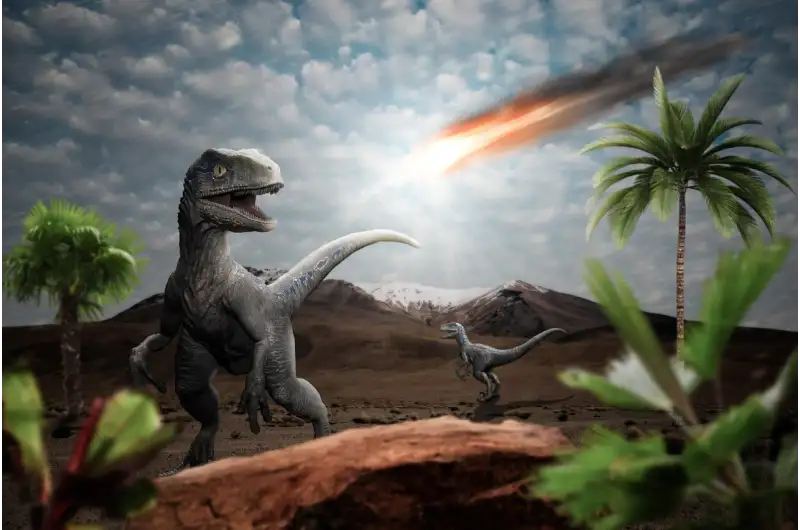
The six-mile-wide (10-kilometer-wide) Life on Earth was irrevocably altered when the Chicxulub asteroid crashed into Mexico’s Yucatán Peninsula. Only animals that could take refuge in tunnels or shallow waterways survived into the era of mammals that followed the end of the dinosaur era.
In the immediate aftermath of the impact, there was a strong heat pulse due to friction between the atmosphere and debris falling back to Earth. “We’re in the realm where we might be essentially killing off everything within that first hour or two,” stated Brandon Johnson, a planetary scientist at Purdue University and the study’s lead author.
According to a recent study, a thick, global blanket of dust most likely insulated the atmosphere, trapping and radiating enough heat down to the surface to ignite worldwide wildfires and burn even the thickest-skinned animals to a crisp. This finding reignites the long-running discussion of whether the dinosaurs were killed by an asteroid collision or by some other aftereffect.