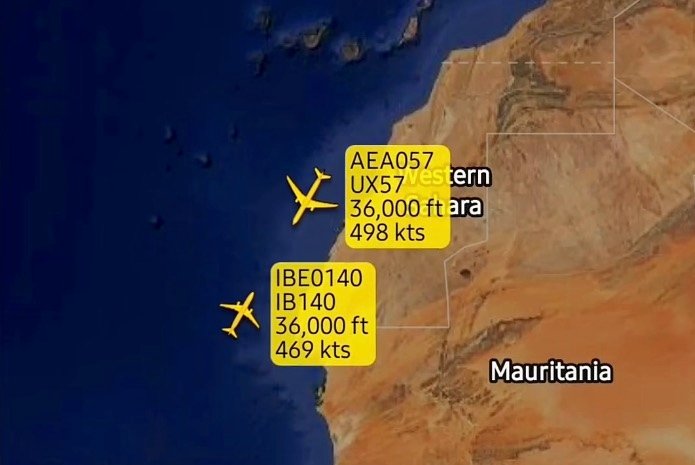
Canary islands airspace tcas event At 36,000 feet (about 11,000 meters), onboard automatic safety systems overrode traditional air traffic regulations, preventing a potentially disastrous mid-air collision between two commercial aircraft in the early hours of July 10, 2026.
On a single maritime airspace, an Iberia Airbus A321 and an Air Europa Boeing 787-9 found themselves flying straight for one another at precisely the same altitude.
The near miss happened at 01:23 UTC in the oceanic sector of the Canary Islands Flight Information Region (FIR/UIR), a vital airspace corridor connecting Europe, Africa, and the Americas that is overseen by the Spanish air navigation service provider ENAIRE, according to data released by Spain’s Independent Professional Union of Air Traffic Controllers (SPICA).
Between the oceanic reporting sites ETIBA and BIPET, Iberia aircraft IBE0140, an Airbus A321 with registration EC-OLE, was travelling northeast on airway N857. At the same moment, Air Europa flight AEA05, a Boeing 787-9 Dreamliner (registration EC-NBM), was flying in the opposite direction but along the same airway at Flight Level 360.
The Traffic Alert and Collision Avoidance System (TCAS), the aviation industry’s ultimate safety net, activated on both flight decks as the two aircraft closed in on one another at a combined speed approaching 1,000 mph (1,600 km/h).
Bypassing any ground-based orders, the onboard transponders autonomously cross-communicated to produce complementary vertical escape manoeuvres following an initial Traffic Advisory warning:
- The Iberia Airbus A321 received a strict “TCAS RA DESCEND” order, prompting the crew to dive approximately 500 feet.
- The Air Europa Boeing 787-9 was simultaneously ordered to “TCAS RA CLIMB,” initiating a rapid 400-foot ascent.
Both crews received a “CLEAR OF CONFLICT” warning and were able to safely return to their planned flight routes when the automated systems verified that safe vertical separation had been restored. Both planes arrived at their destinations without any additional issues, and neither aircraft reported any damage or injuries.
We occasionally witness near-misses with commercial aircraft. Generally speaking, the likelihood of a close approach increases with proximity to an airport because this is also the most crowded airspace.
Here’s something you don’t often see: two planes were cruising over the Atlantic Ocean and going straight for each other at the same altitude. Fortunately, as usual, TCAS came to the rescue. But one wonders how this error occurred in the first place.